What Is an End-to-End Supply Chain?
An end-to-end supply chain integrates the many supply chain activities within an enterprise into one continuous workflow: from procurement, forecasting, and planning, through manufacturing, distribution, and storage, to transportation, delivery, sales, and customer service. This is in stark contrast to the disconnected activities of a traditional supply chain. An end-to-end supply chain does not just focus on each individual stage, but also considers how these stages interact with one another. The goal is to build a comprehensive picture of the enterprise's supply chain. From there, the enterprise can optimize its entire operating process, minimize costs, and increase customer satisfaction.
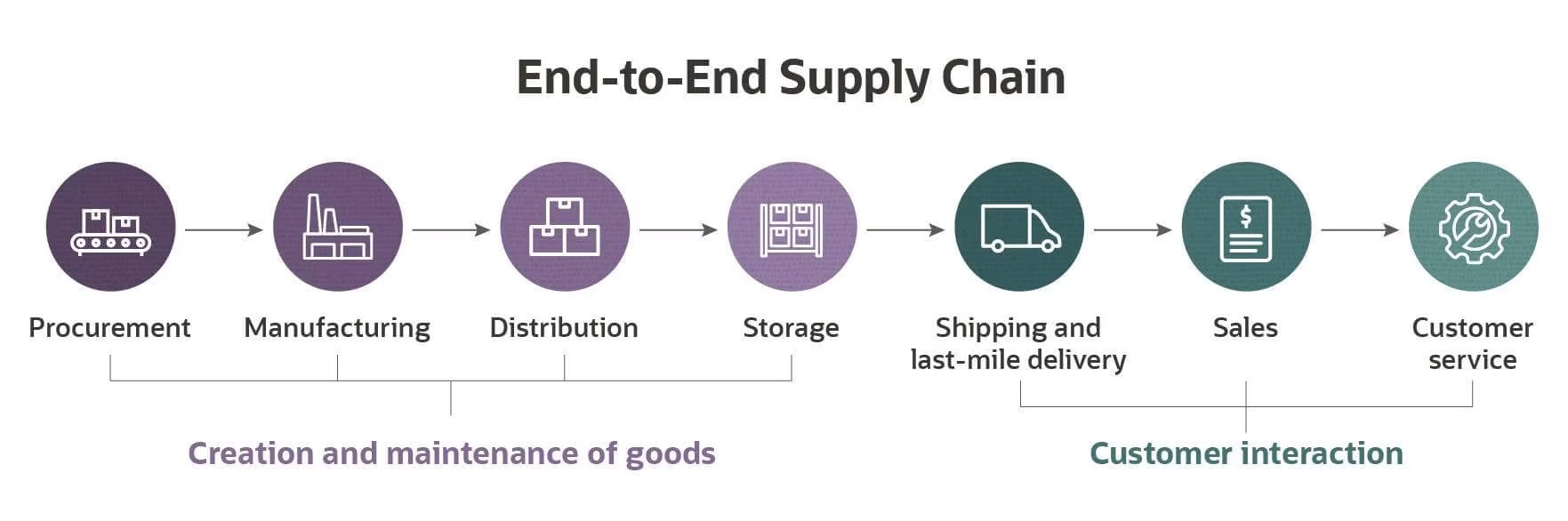 An end-to-end supply chain can provide a comprehensive picture of an enterprise's supply activities by examining the relationship between each step in the supply chain, rather than treating them as separate, isolated activities.
An end-to-end supply chain encompasses all of an enterprise's supply activities. At the same time, this process allows the enterprise to track its supply chain continuously and end to end. Therefore, whenever any activity in the supply chain changes, the enterprise must consider it from 2 angles: How does this change affect the activity itself, and how does it affect other activities in the supply chain? In this way, the goal of end-to-end supply chain management is to optimize each activity without negatively impacting the rest of the process.
Take raw material procurement as an example. Viewed in isolation, the goal of this activity is to source the cheapest raw materials possible. In an end-to-end supply chain, however, the enterprise must also weigh the cost benefit against the time-related risk if these cheaper materials are not quality-assured or are not supplied consistently. Moreover, when input materials are of poor quality, the enterprise must also strengthen quality control to ensure efficient production — which increases labor costs and the potential for material waste during production. As a result, the end-to-end supply chain manager must balance the pros and cons of these factors so as to optimize costs without compromising input quality or the subsequent steps of the supply chain.
 The goal of end-to-end supply chain management is to optimize each activity without negatively impacting the rest of the process.
Comparing End-to-End Supply Chain with Traditional Supply Chain
End-to-end and traditional supply chains both share the same goal: reducing costs and creating products/services that meet customer needs. Both approaches involve similar activities such as manufacturing, transportation, and customer service. However, a traditional supply chain typically treats each activity as an independent process, with its own needs and objectives. An end-to-end supply chain, on the other hand, treats each activity as a small piece of a larger process that integrates many different steps.
In a traditional supply chain, information flows in one direction (from factory to customer). This means the manager optimizes output based on input that results from earlier activities in the supply chain. Essentially, this one-way information flow reflects how raw materials and finished goods move along the supply chain to reach the customer.
With an end-to-end supply chain, on the other hand, the manager must analyze information from both directions (from factory to customer and from customer back to factory). This means that, in addition to the information needed in a traditional supply chain, the manager must also understand which stages are involved in the supply chain in order to work backward through the factors needed to create the product and how these stages interact with one another. Combining both directions of information is what forms the end-to-end supply chain.
 With an end-to-end supply chain, the manager must analyze information from both directions (from factory to customer and from customer back to factory) to maintain a comprehensive view of the entire supply chain.
To compare these two approaches, Citek will use the example of a production manager. In a traditional supply chain, the production manager has very little information about the procurement process, other than the input materials they receive from the procurement team. That same manager, however, working within an end-to-end supply chain, has access to all the information they need — from procurement and production to subsequent stages such as transportation and delivery — allowing them to optimize their own production operations. To observe such a comprehensive picture, an end-to-end supply chain manager must constantly retrieve large volumes of data. As a result, they need to apply new technologies, such as cloud-based software, to update information quickly and accurately across an enterprise's highly complex supply chain.
Comparison Table: End-to-End Supply Chain vs. Traditional Supply Chain
|
End-to-End |
Traditional |
| Goal |
Reduce costs and create products/services that satisfy customer needs |
Reduce costs and create products/services that satisfy customer needs |
| Perspective |
The entire supply chain is treated as a unified process |
Each step in the supply chain is treated as an independent process |
| Method |
Managers analyze two-way information to observe the entire process |
Managers use one-way information flow to focus on their own specific tasks. |
| Outcome |
A comprehensive, unified supply chain operated as one continuous workflow |
Problems arise when a step in the process is changed without anticipating the impact on the remaining steps |
Benefits of an End-to-End Supply Chain
End-to-end supply chain management also delivers the same benefits as the traditional approach — such as cost savings, an improved customer experience, and fewer issues arising. But beyond that, this approach offers the following additional advantages:
1. More Efficient Operations
If a business only focuses on solving problems as they arise without looking at the supply chain as a whole, the solution it implements may end up stalling the entire process. For example, shortening the sales process can make customers more likely to skip or not carefully read the return, warranty, and related service policies. At first glance, this solution appears to help the sales process, but in reality it places an additional burden on the Customer Service and Reverse Logistics teams. End-to-end management helps enterprises build a unified, seamless supply chain, avoiding improvements that create problems affecting the entire process.

2. Reduced Risk of Delays or Disruptions in the Supply Chain
Problems can arise anywhere in the supply chain, from a supplier suddenly ceasing operations to delivery routes being blocked by natural disasters. End-to-end management allows enterprises to track supply chain activities from start to finish. As a result, decision-makers can identify vulnerabilities and develop contingency plans in case something goes wrong — for example, diversifying suppliers and delivery partners, or reallocating inventory across regions.
3. Increased Customer Satisfaction
The goal of supply chain management is to build a reliable process with more affordable pricing for both the enterprise and the customer. With an end-to-end supply chain, the enterprise gains more detailed order information as well as more accurate delivery timelines, thanks to continuously updated information from every stage of the production process.
This related information can also be shared directly with customers. So even in the event of a delay, the enterprise can notify customers more quickly, along with continuously updated timelines. This has a direct impact on the customer experience and satisfaction.

4. Building Strong Relationships with Suppliers
For enterprises, an end-to-end supply chain makes the ordering process more transparent and organized. As a result, suppliers gain a clearer understanding of exactly what the enterprise needs, as well as the precise timing and location, avoiding rushed orders or last-minute deliveries. Furthermore, strong relationships with suppliers make it easier for enterprises to secure discounts or price reductions.
5. Transparency in Operations and Inventory
With an end-to-end supply chain, enterprises can track each stage of production in detail to avoid “bottlenecks,” inventory surpluses or shortages, and production delays. However, capturing the full end-to-end supply picture requires a large volume of data. As a result, some enterprises — particularly e-commerce businesses — use software or integrated platforms to organize data more effectively. At the same time, the system also grants access to managers at different levels.
6. Better Data Analysis, Forecasting, and Improvement
All data collected from an end-to-end supply chain can be used to forecast customer demand, production schedules, and more. Rather than producing based on intuition, accurate demand forecasting helps ensure sufficient stock is always available at points of sale, while reducing transportation costs and waste. In addition, accurate data helps managers identify gaps or outdated elements in the supply process so they can be addressed before larger problems arise.

Choose Growth, Choose NetSuite
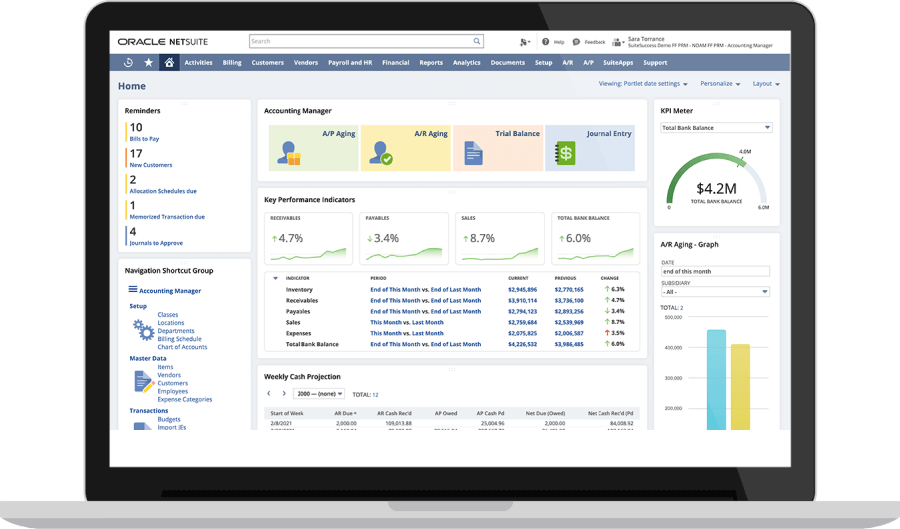
Every enterprise needs to manage its supply chain, but not every enterprise has the resources to collect and analyze the data required to manage an end-to-end supply chain effectively. Oracle NetSuite's Supply Chain Management module can do this work on the enterprise's behalf.
NetSuite runs on a cloud-based platform, giving users accurate, real-time data. This allows managers to track each stage of the supply chain in detail to optimize their workflow. At the same time, managers can also see the bigger picture to understand how new improvements affect the rest of the supply chain.
Conclusion
As we can see, an end-to-end supply chain is a new approach that helps enterprises manage their supply chain comprehensively and seamlessly. This approach offers more benefits than a traditional supply chain, though it also comes with certain challenges. To learn about the stages of an end-to-end supply chain, as well as its strengths and challenges, follow Citek's latest articles HERE!
