 Join Citek in exploring the advantages and disadvantages of accounting software compared to an enterprise resource planning (ERP) system
What Is Accounting Software?
As its name suggests, "accounting software" is software focused on an enterprise's financial activities. It helps track and control accounts receivable and accounts payable, alongside other activities such as general ledger accounting, fixed asset accounting, and loan tracking. A clear example is the system's ability to support accountants in checking double-entry bookkeeping data, ensuring that data is always recorded completely and accurately.
What Is ERP?
ERP is an integrated system that helps enterprises run most of the activities within their organization. Its database consolidates input from multiple departments, including Accounting, Human Resources, Manufacturing, Marketing, Sales, Supply Chain, and others. As a result, business leaders can gain a comprehensive view of the company through a single, unified database. In addition, ERP helps enterprises automate business processes while identifying gaps in those processes to drive continuous improvement and performance.
ERP first emerged in 1990, when Gartner identified it as a distinct category of software. ERP systems have supported many large companies and corporations for decades. Today, with the growth of cloud computing, cloud-based ERP has also become accessible to small and medium-sized companies.
Learn more about ERP: What Is ERP? The Benefits of ERP Systems in Enterprise Management

What Is the Difference Between ERP and Accounting Software?
For small businesses, once you reach a certain scale, you'll notice you're spending more and more time processing paperwork. Tasks that were once easily managed in Excel gradually become overwhelming for accountants. At this point, business leaders start looking for automation solutions, and the first thing that usually comes to mind is accounting software. This solution immediately solves the common problems of a growing business, such as tracking sales revenue, collecting payments, paying suppliers, and calculating profit.
However, accounting software cannot, on its own, track supplier activities and progress, manage a growing headcount, or provide real-time information on warehouse costs and operations. As a result, alongside accounting software, enterprises also have to use separate spreadsheets or other software to manage HR, production, customers, and more.
 Accounting software solves common problems such as tracking sales revenue, collecting payments, paying suppliers, and calculating profit
…Or consolidate all data on a single ERP system. ERP includes not only an Accounting module with functionality similar to standalone accounting software, but also other modules such as supply chain management, customer relationship management (CRM), and human resource management (HRM). This allows leaders to control an enterprise's entire operations through a single system. At the same time, businesses can uncover important insights from cross-departmental activity — something very difficult to do when data is scattered across multiple sources. The table below compares the specific advantages and disadvantages of accounting software versus an ERP system.
Comparison Table: Key Differences Between ERP and Accounting Software
| Criteria |
Accounting Software |
ERP |
| Functionality |
Focused solely on accounting |
Manages nearly every aspect of business operations |
| Analysis |
Limited to analyzing financial data |
Can analyze insights across multiple departments |
| Reporting |
Can only generate reports based on financial information |
Can provide standalone reports or reports combining both financial and operational data |
| Scalability |
Scalability is limited by the maximum number of users and customer records each software can store |
Can scale to serve businesses from small to large |
| Cost |
Relatively inexpensive, suitable for small businesses |
Higher cost, though a cloud-based system can make it more affordable |
| Deployment |
Easy to deploy, and can even be customized for each business's specific needs |
Requires thorough need analysis and a business case before implementation |
| Usability |
Easy to use; can be self-taught |
Takes considerable time to learn before all functions can be fully leveraged |
Why Is ERP the Right Choice for Growth?
In their early days, companies typically handle work on a case-by-case basis, tackling issues as they arise. However, as a business grows, this approach is no longer sufficient. At this stage, order volumes are no longer in the dozens or hundreds, but can reach into the thousands or tens of thousands. Supply sources are also no longer confined to the local city, but may come from overseas with shipping times measured in weeks or months. As a result, enterprises need an automated system to control and plan for this work.
With multiple modules capable of supporting a wide range of business activities, ERP is the option that offers the best automation and scalability for growing companies. In addition, ERP gives leaders a comprehensive view of their business by consolidating all processes and functions into a single database. This allows leaders to run their enterprise more consistently and effectively.
 ERP offers better automation and scalability than accounting software
Take, for example, a business carrying out its order-to-cash process. This process begins when the sales team closes a deal or a customer places an order directly through the website. The request is then passed to the warehouse team. The warehouse keeper lists the products in the order, picks them from the shelves, records them as removed from inventory, and hands them off to the shipping team. Once the goods are shipped, the accounting team issues the invoice. As you can see, information flows continuously between departments. Handling all of these activities manually would take a great deal of time and carry a higher risk of errors. On an ERP system, by contrast, much of this process is automated, processed faster, and subject to significantly less risk.
Furthermore, thanks to its integrated data and real-time visibility, ERP makes it easy for leaders and managers to monitor the company's operations. This enables more effective production and business scheduling and planning, while also automating the supply chain. In the example above, when warehouse stock is running low, the purchasing and accounting teams can quickly receive that information through the ERP system and replenish inventory in time.
Choose Growth, Choose NetSuite
As revenue starts to grow, the first thing small businesses usually think of is accounting software. At this stage, the basic goal is to resolve overwhelmed financial operations. The Accounting and Finance functionality within NetSuite ERP provides an immediate solution for these businesses. Beyond that, NetSuite ERP also helps enterprises quickly access key financial figures and stay compliant with the latest accounting and tax standards.
However, once the accounting issue is resolved, companies quickly realize that other areas of the business also need software and automation — something as simple as an automated email system to process orders more promptly. NetSuite ERP supports operations across many different departments within an enterprise, including order and inventory management, human resource management, customer management, warehouse management, project management, and supply chain management.
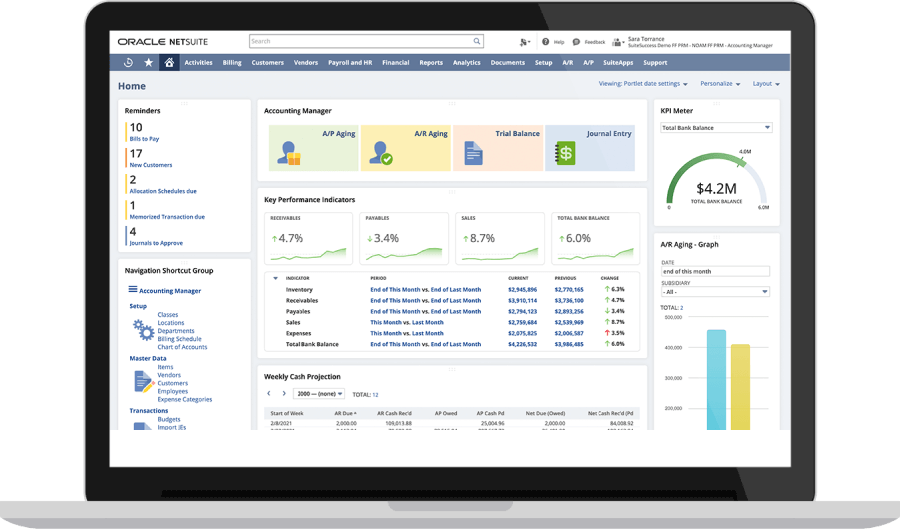 NetSuite ERP also helps enterprises quickly access key financial figures and stay compliant with the latest accounting and tax standards.
Conclusion
In short, if your business is looking for an inexpensive, simple option to solve accounting alone, then accounting software is the right choice for you. But if you want to manage and plan all of your business's resources effectively to drive growth and development, a True Cloud ERP system is the optimal solution. CONTACT Citek for more specific guidance on ERP and accounting software!